
The Definitive Guide to Shopify Plus Migration: An Enterprise Framework for Scalability and SEO Preservation
Introduction: The High-Stakes Shift to Shopify Plus
In the current era of “Revenue Engineering,” the platform you choose is no longer just a place to host products; it is the engine of your entire business. For scaling brands, the transition from legacy systems like Adobe Commerce (Magento), Salesforce Commerce Cloud, or WooCommerce to Shopify Plus represents a pivotal moment in their growth trajectory.
However, an enterprise-level migration is a high-stakes operation. A single misstep in data mapping or a broken redirect chain can result in a 30-40% drop in organic revenue overnight. At TechCure, we view migration not as a “copy-paste” task, but as a total re-engineering of your digital ecosystem. This guide outlines the exact framework we use to ensure zero-loss transitions for high-volume global brands.
I. The Strategic Audit: Beyond the Surface
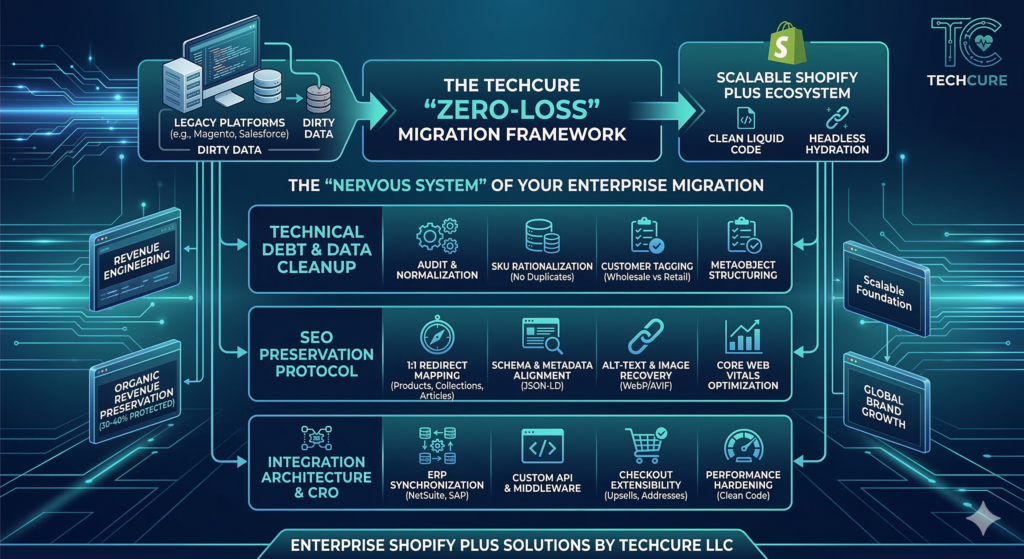
Before any data is moved, a Senior Migration Strategist must conduct a deep-dive audit of the existing tech stack. Most agencies fail because they only look at the “Frontend.” We look at the “Nervous System.”
1. Technical Debt Assessment
Legacy platforms often carry years of “custom patches” and “plugin bloat.” We identify:
- Redundant Scripts: Third-party tracking codes that are no longer active but slow down the site.
- Hard-Coded Logic: Business rules that were “hacked” into the old core and need to be rebuilt as clean Shopify Functions or Metaobjects.
2. Database Normalization and Cleanup
Your old database is likely “dirty.” Migrating poor data to a new platform just creates new problems.
- SKU Rationalization: Consolidating duplicate products and cleaning up variant logic.
- Customer Tagging: Segmenting your historical customer data (Wholesale vs. Retail) to ensure the new Shopify CRM is organized from Day 1.
II. SEO Preservation: The “No-Drop” Protocol
For a high-ticket brand, “Organic Search” is the lifeblood of the business. Losing your Page 1 rankings during a move is not an option.
1. The 1:1 Comprehensive Redirect Map
We use advanced crawling tools to identify every single URL that has ever been indexed by Google. We then create a 301 Redirect Strategy that maps:
- Old Product URLs $\to$ New Shopify Product Handles.
- Old Category/Layered Navigation $\to$ New Shopify Collections.
- Old Blog/Resources $\to$ New Shopify Articles.
2. Metadata and Schema Alignment
Google’s crawlers rely on Structured Data (JSON-LD) to understand your products. We ensure that your “Price,” “Availability,” and “Review” snippets are perfectly translated to Shopify’s schema. This prevents the “Rich Snippet” loss that often occurs during migrations.
3. Image SEO and Alt-Text Recovery
Most agencies forget the “Images” tab of Google Search. We export all historical Alt-text and ensure that images are served via WebP/AVIF formats on the new CDN to maintain image ranking authority.
III. Integration Architecture: Connecting the Backend
An enterprise store does not live in a vacuum. It must communicate with your ERP, 3PL, and CRM.
1. ERP Synchronization (NetSuite, SAP, Microsoft Dynamics)
For North American retailers, real-time inventory is non-negotiable. We build custom middleware (or utilize high-end connectors) to ensure:
- Inventory Levels: Synced across multiple warehouses (Multi-Location Inventory).
- Order Routing: Orders are automatically pushed to the correct fulfillment center based on the customer’s zip code/postal code.
- Financial Reconciliation: Automatic tax and accounting syncing to simplify end-of-month reporting.
2. The Role of Middleware and Custom APIs
Sometimes, an “off-the-shelf” app isn’t enough. If you have a unique business model—such as complex wholesale pricing or bespoke subscription logic—we develop Custom Private Apps. This allows us to keep the Shopify “Core” clean while delivering the specific functionality your business requires.
IV. The Design Pivot: UX for Conversion (CRO)
Migration is the perfect time to address Conversion Rate Optimization (CRO). We don’t just “clone” your old design; we improve it.
1. Reducing Checkout Friction
Shopify Plus offers Checkout Extensibility. We use this to:
- Add Trust Signals (Secure Payment Icons).
- Implement Address Validation (Crucial for reducing “Return to Sender” costs).
- Integrate Post-Purchase Upsells to increase Average Order Value (AOV) instantly.
2. Mobile-First Navigation
With over 70% of e-commerce traffic now coming from mobile devices, we engineer “Thumb-Friendly” navigation and fast-loading product galleries. We focus on the LCP (Largest Contentful Paint) to ensure the user sees the main product image in under 1.5 seconds.
V. Performance Engineering and Core Web Vitals
Speed is a ranking factor and a conversion factor. Our migration process includes a mandatory “Speed Hardening” phase.
1. Clean Liquid Code vs. Heavy Themes
We avoid “Kitchen Sink” themes that come with 50 features you don’t use. Instead, we build on top of Shopify 2.0 frameworks using clean, optimized Liquid code.
2. The Headless Option (Hydrogen & Oxygen)
For brands that require absolute control over the frontend, we offer Headless Commerce transitions. By decoupling the frontend from the backend, we can achieve sub-second load times and a truly “App-like” feel on the web.
VI. Testing and Quality Assurance (QA)
We never “Go Live” without a rigorous testing phase.
- UAT (User Acceptance Testing): Ensuring your team knows how to use the new Shopify Admin.
- Payment Gateway Testing: Real-money transactions to ensure Stripe, PayPal, and Apple Pay are working flawlessly.
- Cross-Browser Testing: Ensuring the site looks perfect on Chrome, Safari, and Edge.
VII. Post-Launch: The Growth Phase
Migration is only the beginning. Once the site is live, we transition into a Growth Partnership.
- A/B Testing: Iterating on landing pages to squeeze more profit from your traffic.
- Retention Strategy: Implementing loyalty programs (like Yotpo or Smile) to increase the LTV (Lifetime Value) of your customers.
Conclusion: Partnering with a Migration Expert
A Shopify Plus migration is a complex, multi-departmental project. It requires a partner who understands the nuance of Technical SEO, Enterprise Integration, and UX Design. At TechCure, we have spent over 15 years perfecting this process for brands that refuse to settle for “average.”
If your current platform is a bottleneck for your revenue, it is time to build a scalable foundation. Let us handle the technical heavy lifting so you can focus on leading your brand.
Ready to discuss your migration roadmap? Consult with our Senior Developers for a risk-free technical assessment.