In competitive digital commerce environments, design alone does not drive sustainable growth. Without a structured conversion system in place, even high-traffic Shopify stores underperform at the revenue level.
That’s where Shopify CRO (Conversion Rate Optimization) becomes essential. Shopify CRO focuses on improving your store’s structure, user experience, speed, and checkout process to increase ecommerce conversion rate and maximize revenue.
Whether you’re working with experienced Shopify consultants or investing in professional Shopify development services, optimizing for conversions is the fastest way to scale a growth-focused ecommerce business.
What is Shopify CRO and Why It Matters
Shopify CRO (Conversion Rate Optimization) is the process of improving your Shopify store to increase the percentage of visitors who complete a desired action — usually making a purchase.
Instead of spending more money on ads, Shopify CRO focuses on maximizing the value of your existing traffic. By improving product pages, checkout flow, speed, and trust signals, businesses can significantly increase ecommerce conversion rate without increasing marketing costs.
In mature ecommerce markets, incremental improvements in conversion rate often generate greater long-term profitability than increasing advertising spend.
Let’s break down exactly how to optimize your Shopify store for higher conversions.
Why Strategy Matters in Shopify CRO
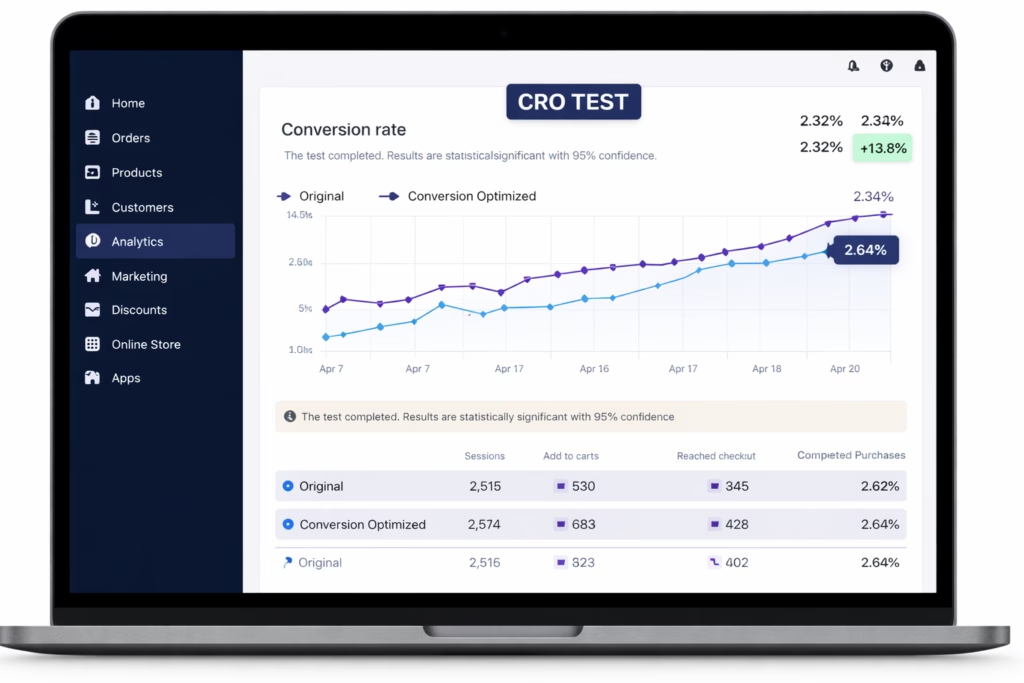
Shopify CRO isn’t about changing button colors or adding countdown timers. It’s a structured, data-driven process that combines analytics, behavioral psychology, UX design, and performance optimization to systematically increase conversion rates.
Our Shopify CRO Framework
Our Shopify CRO methodology is built around measurable growth, behavioral data, and performance engineering — not assumptions.
Our Shopify CRO framework includes:
- Behavioral data analysis & heatmap tracking
- Funnel performance audit (product → cart → checkout)
- Checkout optimization & friction removal
- Speed & technical performance improvements
- Mobile-first UX restructuring
- Structured A/B testing for revenue growth
For scaling ecommerce brands, conversion optimization is not a one-time fix — it’s an ongoing revenue growth system.
Key Areas of Shopify Conversion Optimization
Effective Shopify CRO is not limited to small design tweaks. It requires systematic optimization across the entire customer journey.
In highly competitive digital commerce environments, conversion performance depends on several interconnected factors:
- Product page clarity, positioning, and trust architecture
- Checkout friction removal and payment flexibility
- Cart abandonment mitigation strategies
- Performance engineering and load speed optimization
- Mobile-first UX refinement
- Structured trust reinforcement throughout the funnel
Scaling ecommerce brands treat conversion optimization as an integrated revenue system — not a single-page adjustment.
Even marginal improvements across these areas can generate measurable revenue impact in mature online markets where customer expectations are high and switching behavior is immediate.
Ready to Improve Your Shopify Conversion Rate
If your Shopify store is generating traffic but not maximizing revenue, it’s time to evaluate your conversion architecture.
At TechCure, we work with growth-focused ecommerce brands across the USA and Canada to improve conversion rates through structured audits, performance optimization, and data-driven CRO frameworks.
If you’re serious about scaling your revenue — not just redesigning your store — schedule a Shopify CRO consultation today.
The Revenue Impact of a 1% Conversion Increase
In advanced ecommerce markets where customer acquisition costs are high and competition is intense, even marginal conversion improvements create meaningful financial impact.
Let’s look at a simplified example.
If your Shopify store receives:
- 40,000 monthly visitors
- 2% conversion rate
- 800 monthly orders
Now increase conversion rate from 2% to 2.3%.
That results in:
- 920 monthly orders
That’s 120 additional orders — without increasing traffic.
If your average order value is $120, that equals:
- $14,400 additional monthly revenue
- $172,800 additional annual revenue
From a 0.3% improvement.
In premium ecommerce environments, where traffic is expensive and customer expectations are high, conversion efficiency becomes a strategic growth lever — not just a design upgrade.
This is why Shopify CRO is not cosmetic optimization. It is revenue engineering.
Product Page Conversion Optimization Strategy
For many Shopify stores, the product page is the primary decision environment. If the product page fails to build clarity, trust, and urgency, conversion friction begins long before checkout.
High-performing Shopify product pages typically focus on:
- Clear value positioning above the fold
- Immediate trust reinforcement (reviews, guarantees, shipping clarity)
- Structured benefit-driven copy
- Optimized image hierarchy and zoom clarity
- Mobile-first layout prioritization
- Simplified variant selection
In mature ecommerce markets, customers expect instant clarity. They do not read long paragraphs — they scan. This makes information hierarchy critical.
In our experience optimizing growth-focused Shopify brands, even small adjustments to product page structure — such as repositioning trust elements or simplifying variant selection — have resulted in measurable increases in add-to-cart rates within weeks.
Product page CRO directly influences the entire funnel. If the product page converts efficiently, the checkout stage becomes significantly easier to optimize.
Cart Optimization Strategy
Cart abandonment remains one of the largest sources of revenue leakage in ecommerce.
While some abandonment is natural comparison behavior, a significant portion is driven by preventable friction.
Strategic cart optimization focuses on:
- Transparent shipping communication
- Clear return policy visibility
- Simplified cart layout
- Free shipping threshold clarity
- Exit-intent recovery logic
- Urgency framing without manipulation
In competitive digital commerce environments, customers often compare multiple stores simultaneously. If the cart experience introduces confusion, hidden costs, or unnecessary steps, abandonment increases immediately.
Cart optimization bridges the psychological gap between intent and commitment. Removing uncertainty at this stage increases the likelihood that users proceed confidently into checkout.
Advanced Checkout Optimization Strategy
Checkout represents the highest-intent stage of the buying journey.
At this point, persuasion is largely complete. What matters is speed, clarity, and trust.
Effective Shopify checkout optimization includes:
- Streamlined form fields
- Mobile keypad optimization
- Reduced cognitive load
- Payment flexibility
- Express checkout enablement
- Visible security messaging
- Performance optimization to reduce delay
In high-income ecommerce markets, customers expect frictionless checkout experiences similar to industry-leading platforms. Even minor delays or confusion can disrupt purchase momentum.
Optimizing checkout completion rate is one of the highest-leverage actions available to scaling Shopify brands.
Mobile-First Conversion Optimization
In modern ecommerce, the majority of transactions begin — and often complete — on mobile devices.
However, many Shopify stores are still optimized primarily for desktop.
Mobile CRO focuses on:
- Thumb-friendly layout structure
- Larger tap targets
- Simplified navigation
- Reduced scrolling friction
- Compressed loading sequences
- Clear CTA visibility
Mobile shoppers are typically more impatient and more comparison-driven. Optimizing for mobile is no longer optional — it is foundational to conversion performance in competitive markets.
The Role of Data in Sustainable CRO
Sustainable Shopify CRO is never based on assumptions.
It requires structured measurement.
This includes:
- Heatmap analysis
- Scroll depth tracking
- Funnel drop-off analysis
- Session recording review
- Structured A/B testing
- Revenue attribution modeling
Without measurement, optimization becomes guesswork.
With measurement, conversion improvements compound over time.
For growth-focused ecommerce brands operating in high-value markets, structured testing cycles create predictable revenue growth.
When Should a Shopify Store Invest in CRO?
Conversion optimization becomes critical when:
- Traffic is stable but revenue plateaus
- Customer acquisition costs increase
- Cart abandonment rates are high
- Checkout completion rate underperforms
- Scaling through ads alone becomes inefficient
In advanced ecommerce markets, brands that prioritize conversion efficiency outperform competitors who focus solely on traffic expansion.
Frequently Asked Questions About Shopify CRO
What is a good ecommerce conversion rate?
Conversion rate varies by industry and traffic quality. Instead of focusing on industry averages, serious ecommerce operators focus on incremental improvement. Even a 1–2% lift in conversion rate can significantly impact annual revenue in competitive markets.
How long does Shopify CRO take to show results?
When traffic volume is sufficient and optimization is structured, measurable performance improvements can often be observed within 30–60 days.
Is Shopify CRO only for large stores?
No. Mid-sized stores operating in competitive markets often benefit the most because conversion inefficiencies are easier to identify and improve.
Does CRO require a full redesign?
Not necessarily. Many high-impact CRO improvements involve structural adjustments, clarity enhancements, speed optimization, and friction removal — not full visual overhauls.
Final Perspective: Conversion Efficiency as a Competitive Advantage
In competitive digital commerce environments, growth does not belong to the brands spending the most.
It belongs to the brands converting the most efficiently.
Shopify CRO transforms your store from a static ecommerce website into a structured revenue engine.
For growth-focused brands operating in high-income markets where customer expectations are elevated and switching costs are low, conversion efficiency becomes the defining competitive advantage.
Traffic generates opportunity.
Conversion generates revenue.