
Shopify Checkout Optimization: A Strategic Guide to Higher Conversion Rates
In today’s competitive ecommerce landscape, optimizing your Shopify checkout is no longer optional — it’s a direct driver of revenue growth.
Many brands focus heavily on traffic acquisition, but the real opportunity lies at the final and most critical stage of the funnel: the checkout process. Even small improvements in checkout speed, clarity, trust signals, and payment experience can dramatically increase completed purchases without increasing ad spend.
Shopify checkout optimization is about removing friction, reducing cart abandonment, and systematically improving conversion rates to maximize revenue from your existing traffic.
Why Checkout Is the Highest-Leverage Revenue Stage
In ecommerce, most growth strategies focus on traffic acquisition — paid ads, SEO, influencer campaigns, and new channel expansion. While driving traffic is important, sustainable revenue growth rarely begins at the top of the funnel.
It begins at the bottom.
The checkout stage is where buying intent is at its highest. By the time a customer reaches checkout, they have already discovered your brand, evaluated the product, added items to cart, and committed time and attention. The purchase decision has largely been made.
At this stage, your revenue depends on one thing: eliminating friction.
Checkout does not require persuasion — it requires clarity, speed, trust, and simplicity. Even minor obstacles during this final step can disrupt purchase momentum. Conversely, small improvements at checkout can unlock disproportionate revenue gains.
For growth-focused Shopify brands, checkout optimization is one of the highest-leverage activities available.
The Funnel Math Most Brands Overlook
To understand the impact of checkout optimization, consider a simplified funnel model:
- 50,000 monthly visitors
- 5% add-to-cart rate → 2,500 carts
- 60% checkout completion rate → 1,500 completed orders
Now imagine increasing checkout completion from 60% to 61%.
That 1% improvement results in:
2,500 × 61% = 1,525 completed orders
That’s 25 additional orders per month — without increasing traffic.
With an average order value of $100, that equates to:
$2,500 additional monthly revenue
$30,000 additional annual revenue
From just a one-point increase.
For brands processing thousands of monthly transactions, a 3–5% checkout improvement can represent six-figure annual revenue impact. And unlike paid acquisition, this revenue gain compounds without requiring additional ad spend.
This is why checkout optimization delivers such powerful leverage compared to many top-of-funnel tactics.
Customer Acquisition Cost vs Conversion Optimization
Many ecommerce brands attempt to scale by increasing advertising budgets. However, rising customer acquisition costs make this approach increasingly expensive and margin-sensitive.
If acquisition costs continue climbing, revenue growth becomes dependent on higher spend. This creates pressure on profitability and reduces operational flexibility.
Checkout optimization offers a more sustainable path.
Instead of acquiring more traffic, you increase the efficiency of the traffic you already have. By improving checkout completion rates, you:
- Lower your effective customer acquisition cost
- Improve return on ad spend
- Increase revenue per visitor
- Strengthen overall marketing performance
Sustainable revenue growth does not begin with more traffic — it begins with maximizing the value of existing traffic.
For serious ecommerce brands, checkout optimization is not a minor UX adjustment. It is a strategic revenue decision.
What Shopify Checkout Optimization Actually
Shopify checkout optimization is not about changing button colors or adding urgency banners. It is a structured, data-driven process focused on improving checkout completion rates and eliminating revenue friction.
A strategic checkout optimization framework typically includes:
- Checkout flow analysis
- Mobile checkout usability improvements
- Payment method optimization
- Express checkout integration
- Shipping clarity and transparency
- Form simplification and error handling
- Trust signal placement
- Checkout speed enhancement
- Abandonment recovery analysis
Each of these components influences conversion behavior at the most sensitive stage of the buying journey.
Without a systematic approach, brands often apply surface-level fixes while deeper conversion blockers remain unresolved.
Common Checkout Friction That Reduces Conversion Rates
Even high-traffic Shopify stores experience revenue leakage during checkout. The causes are often subtle but impactful.
Common friction points include:
- Small input fields
- Autocomplete errors
- Poor keypad triggers
- Slow page rendering
- Cluttered checkout layouts
Mobile checkout optimization focuses on simplifying interaction, reducing cognitive load, and accelerating payment completion.
Brands that optimize mobile checkout effectively often see immediate improvements in conversion rate and revenue per visitor.
Payment Optimization and Express Checkout Strategy
Payment flexibility plays a direct role in checkout performance.
High-performing ecommerce brands typically optimize:
- Digital wallet integrations
- Buy now, pay later solutions
- Regional payment preferences
- One-click checkout options
- Secure payment messaging
When customers see their preferred payment method available, purchase hesitation decreases.
Express checkout solutions reduce checkout steps and increase completion speed — especially for returning customers.
Payment optimization is not about offering more options blindly. It is about offering the right options based on customer behavior data.
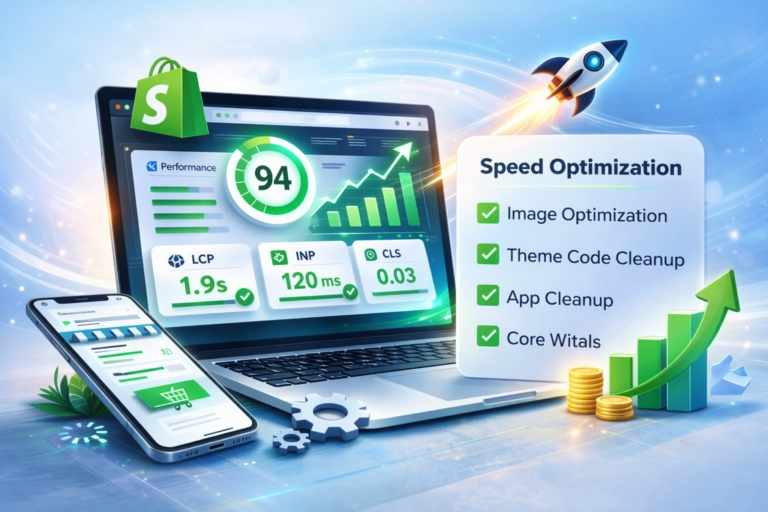
The Role of Checkout Speed in Conversion Performance
Checkout speed directly impacts abandonment rates.
Even small delays during the payment stage increase drop-off risk. Buyers at checkout are ready to purchase — but they are also impatient.
Optimizing checkout speed involves:
- Reducing third-party script conflicts
- Minimizing unnecessary tracking injections
- Improving server response time
- Streamlining payment gateway processing
Speed builds momentum. Momentum drives completion.
Data-Driven Checkout Optimization Framework
Sustainable checkout improvements require structured analysis, not assumptions.
A professional optimization process includes:
Funnel Drop-Off Analysis
Identify where users exit between cart, information, shipping, and payment.
Behavioral Review
Analyze interaction patterns to identify friction.
Technical Audit
Evaluate performance bottlenecks and script load impact.
Hypothesis Development
Identify controlled improvement opportunities.
Structured Testing
Implement measured changes and track performance lift.
Revenue Attribution
Quantify impact on conversion rate and revenue per visitor.
Optimization without measurement is guesswork.
Optimization with data compounds profitability.
Shopify Plus Checkout Customization Opportunities
For brands operating on Shopify Plus, deeper checkout customization becomes possible.
Advanced optimization can include:
- Custom checkout extensions
- Dynamic trust messaging
- Conditional logic blocks
- Checkout-based upsell flows
- Advanced A/B testing
This level of optimization transforms checkout from a static page into a performance engine.
For scaling ecommerce brands, Shopify Plus checkout customization can unlock substantial revenue expansion.
Why Checkout Optimization Compounds Over Time
Unlike paid acquisition, checkout optimization produces recurring revenue gains.
When conversion rate increases:
- Advertising becomes more efficient
- Customer acquisition cost decreases
- Revenue per visitor improves
- Profit margins strengthen
Even a 2–3% sustained improvement in checkout completion can generate long-term revenue expansion without increasing marketing spend.
This is operational leverage — not temporary growth.
Frequently Asked Questions About Shopify Checkout Optimization
How much can checkout optimization increase conversion rates?
Improvements vary depending on traffic quality and existing friction, but many stores see measurable gains between 2% and 10% in checkout completion rate when systematic optimization is applied.
Does checkout optimization require Shopify Plus?
No. Standard Shopify plans allow meaningful optimization through configuration, payment adjustments, and friction reduction. Shopify Plus enables deeper customization but is not mandatory for improvement.
How long does it take to see results?
When optimization is structured and data-driven, measurable impact can often be observed within weeks — especially for stores with significant monthly traffic.
Final Thoughts: Checkout Optimization as a Revenue Strategy
Most ecommerce brands attempt to scale by increasing traffic.
High-performing brands scale by increasing efficiency.
Shopify checkout optimization is not a cosmetic improvement — it is a strategic revenue decision that strengthens profitability, lowers acquisition dependency, and builds long-term growth infrastructure.
For serious ecommerce operators, the checkout is not the end of the funnel.
It is where revenue is secured — or lost.